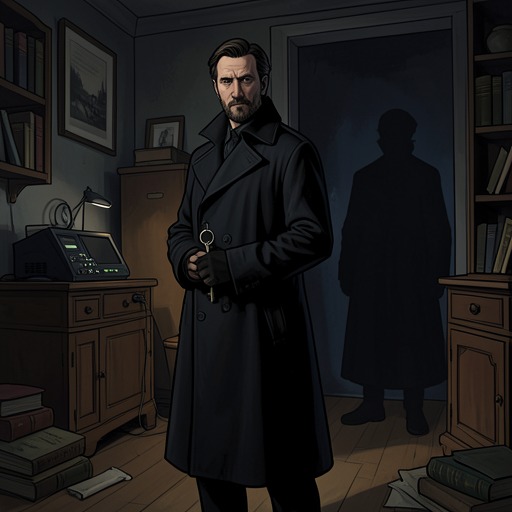
Keith Warner breaks into Zoe’s home and keeps her belongings
The CageKeith Warner breaks into Zoe Hardy’s home and keeps her belongings, turning the trust placed in a locksmith into a means of access. What begins as a complaint about missing objects and signs of disturbance becomes a separate line of suspicion during the police investigation into The Phantom: fingerprints upstairs, a photograph hidden in a drawer, and a holdall containing labelled keys make the intrusion tangible. The evidence points to repeated access and private possession, although it does not establish exactly when each item was taken or how often Warner entered.
From a complaint to a suspect
Zoe Hardy had previously reported that someone had been inside her house and taken some of her things. The objects were small, including ornaments and photographs, and she had also noticed that things were sometimes moved around. The pattern was not simply a broken lock or a single obvious theft: something in the arrangement of her home had changed, while belongings disappeared without an immediately identifiable explanation.
Sheila Ormiston visited Zoe’s house to investigate. Her report supplied the police with fingerprints and a cast of a shoeprint, but one detail gave the prints particular weight: Zoe had changed the locks when she first moved in. Bill Nicol established that Warner had done the work, changing the front and back door locks and fitting locks to the downstairs windows. His prints around those external doors and frames were therefore expected. The prints in the spare bedroom upstairs were not.
The locks had a practical purpose. Warner described a package for people moving into a home, intended to prevent someone with an old key from getting inside; he also said that he used longer screws for safety. That professional explanation made his access to Zoe’s house ordinary in one respect and suspicious in another. He had been there legitimately to secure the property, but the unexplained evidence placed him upstairs, beyond the areas where his work would account for his presence.
Denial and the hidden evidence
When Eve Strong confronted Warner with the upstairs fingerprints, he denied having been upstairs, although he readily admitted doing the lock work. He insisted that Zoe had been with him while he worked. Asked about the missing ornaments and photographs, and the objects that had been moved, he denied knowing anything. He also denied keeping a copy of either the front or back door key, calling that unethical and saying that he had no keys to anyone’s house but his own.
The denials were tested against physical evidence rather than treated as a resolution. Eve told Warner that DS Bill Nicol was applying for warrants to search both his home and his business premises, and asked what belonging to Zoe would be found there. Later, during the search, Eve examined a sideboard. Its top drawer contained make-up, small ornaments, jewellery and photographs. Among them was a photograph in a Perspex holder, lying face down: Zoe reclining on a sun lounger in a bikini, looking over her sunglasses and holding a cocktail glass.
Warner watched Eve’s movements as she searched the sideboard. When she picked up the photograph, he appeared ready to spring from the settee; Gina Cross grabbed his arm and restrained him. His reaction did not itself establish how the picture had reached the drawer, but it intensified the force of the discovery. Jess Thomas then arrived with a black holdall found in a cupboard under the stairs. It contained trainers, a balaclava and several labelled keys, including keys to Zoe’s house. The keys directly contradicted Warner’s claim that he had no copy of them.
Access, collecting and consequences
The investigation connects Warner’s professional access with a much more private relationship to other people’s homes. At the point of confrontation, the police had evidence that his fingerprints were in Zoe’s spare bedroom, her belongings had gone missing or been displaced, and her labelled house keys were in his holdall. The photograph, kept face down among personal items in a drawer, adds a distinct element: the search uncovered not only a means of entry but an image of Zoe retained among Warner’s possessions. The evidence supports a pattern of intrusion and keeping things, without supplying a complete inventory or a precise chronology for each visit.
A separate domestic episode had already framed Rachel Warner’s growing suspicion. When she offered to help keep the housework under control, Warner rebuked her, left the room and told her not to raise the matter again. Rachel wondered what he had to hide and considered calling the confidential hotline. That episode records suspicion rather than proof of the Zoe offences, and it should not be confused with the later physical evidence from Zoe’s home and the holdall. It does, however, place concealment around Warner in the narrative before the search makes the evidence unmistakable.
The discovery occurs while the police are also dealing with The Phantom and the people responsible for the Briggs twins’ deaths. At the hospital, Bill Nicol assesses the holdall as likely to be enough to put Warner away and suggests that, if Warner liked the look of someone, he cut an extra set of keys to that person’s house. This is the investigators’ conclusion about a possible recurring method, not a detailed account of every target or entry. The same exchange draws a clear boundary between offences: Warner is described as having committed serious invasions of privacy, but he had not killed anyone. His case is resolved through the convergence of a locksmith’s access, unexplained upstairs prints, Zoe’s account of missing and moved objects, and the keys and photograph found during the search.